Showing posts sorted by relevance for query morocco. Sort by date Show all posts

Sunday, March 05, 2006

Tainted


I awoke Monday morning to the sunny Mediterranean Sea just coming into view… a greenish blue calm settling over me, accented by the surprising silence of the 15 of us in the van. It was a long four days, and as we drove along the road bordering the sea I think we were all thinking about how exhausted, dirty, and changed we felt. Either that, or we were sleeping.

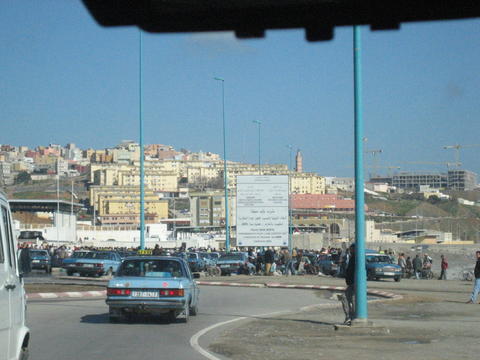
The view was what you might imagine of the Mediterranean: green grass, blue water, sun, a jagged coastline dotted with buildings in the Andalucía-white style. We were headed from the little mountainous town of Chefchaouen to the port, which happens to be in Ceuta, a city in the only region of Morocco still owned by Spain. The poverty of Morocco continued along the sea as we drove, little shacks and souvenir stands on what would be couple-million-dollar property in California. The people were plentiful, walking along the road, most women veiled and most men robed. Where they were going, I don’t know. The parking lot before the border between Morocco and Spain presented the same mystery. It was filled with people, some selling wares, some waiting, and many starting at the 15 of us as we unloaded the van and made our way to the border windows. As we were waiting for our departure from Morocco to be verified, the line of pushing and shoving Moroccans waiting to get across the border got longer and louder. When my passport was stamped and ready, I followed my professor to the front of the line, and watched as the border official yelled at people in Arabic and beat them back to make way for me and my fellow, legal American travelers. We walked rapidly along the sidewalk of the no-man’s zone bordered by high fences and barbed wire, until we finally passed the gate into Spain, the ocean still adjacent but barely visible over the walls and fences surrounding us.


This border between Morocco and Spain in Africa “el tarajal” is the most unequal in the world. The difference in per capita income between third-world Morocco and first-world Spain is astronomical, and this small seaside town of Ceuta is where it all comes to a head. I knew Moroccans had problems getting permission to travel to other countries, because I had several conversations about the matter with three Moroccan friends a few days before in Rabat (the capital). But I wasn’t prepared for the extreme confusion, the frustration, the desperation I saw in the faces and actions of the people at the border. I have no idea what was going on; the languages these nameless faces spoke were French and Moroccan Arabic…possibly others…and it was obvious that the border guards weren’t keen on letting them through for whatever reason. Well, for security reasons, for law reasons, for income and political and nationality and motivation reasons. Maybe not for fairness reasons.


It’s hard for me to understand. I was fortunate enough to be born in the United States, so I’m allowed to travel anywhere in the world at my leisure with my navy blue VIP pass. People like my friend Amine, a bright, motivated Moroccan student about my age who is fluent in Moroccan Arabic, French, and English has never traveled out of Morocco, and probably never will. Another friend Adnan is lucky enough to have traveled to the U.S. and Europe, and he’s hoping to study chemical engineering at UC Berkeley. But even though his family is in the higher level of income in the country, visas out of Morocco are hard to come by.

Yet they’re amazingly welcoming. I only saw this dissatisfaction and desperation in my last taste of Morocco. If I had written Sunday I would have started with this: (see above)

Photos in this post courtesy of Señor Esteban (who also has something to say about Morocco if you're interested). Thank you!

Tuesday, May 02, 2006

my conclusion that was also edited (but not as much)

We could have been anywhere. But were at our home stay in Rabat, Morocco sitting in the comfy patio room with our host family of seven and my American companion was showing the three fascinated brothers of the house his Canon PowerShot SD400 digital camera with 5 megapixels and a 3x digital zoom. The brothers, for their part, were asking all the right questions before all four boys turned back to their heated game of FIFA Soccer 2004 on the family’s Playstation 2. The rest of us were sipping Coca Cola with an Arabic label because we had been told not to drink the water, speaking in bits of English, Spanish, French, and Moroccan Arabic to get our points across the language barrier.

Day three in Africa, a country we had long since found did not have much in the way of Western toilets, toilet paper, showers, or forks. Not that these comforts are the only symbols of civilization; Sevilla doesn’t have much in the way of toilet paper or warm water either. But what many of the people I met in Rabat did have was technology — internet, e-mail, a cell phone, and at least a basic knowledge of English — all things quite foreign to even my host señora in her first-world country of Spain.

The Canon PowerShot saw admiration during its three-day stay in Morocco, but it also saw many decrepit dwellings, skinny children, and poverty. Western consumer products like technology, as well as Coca Cola and good old American fast food, seem to have preceded real assistance in this and many other third-world countries. Because though cameras, video games, computers, and even McDonalds are nice comforts of modernity, they don’t help a country or its citizens sustain themselves. Indeed, the outsourcing and cheap labor now popular among many Western manufacturers further accentuates the divisions between rich countries and poor; these workers often make less in substandard conditions than a comparable worker would make anywhere else.
The thousands of Senegali and Western Saharan immigrants who have arrived on the shores of the Canary Islands or perished in the ocean getting there in the past few months didn’t risk their lives for technology. Granted, technology is part of life in most first-world countries, but first these immigrants seek the jobs, money, and basic comforts for themselves and their families that are not so easily obtained or available in their home countries. Sirifo Kouyate Sakiliba, an immigrant from Senegal that I had the pleasure of interviewing for más o menos 6, admits that he has bought a car in his twelve years in Spain. But more importantly, he provides for his family here in Spain and sends money back to his family in Senegal so his brothers can attend school.

Many of the Moroccans I spoke with didn’t dream about leaving their home country except to travel, a dream impossible for most holding a Moroccan passport. Many others, though, save up to pay the exorbitant prices to get a ticket across the straight to Spain or position themselves around the barbed-wire and high fences separating Ceuta, a colony of Spain, from the rest of Morocco, in hopes of making it over. A few immigrants, like those featured in this magazine, make it across the sea or over the fences, but Spain only has so many jobs to give them.

Those of us lucky enough to hold passports from first-world countries have the luxury to move freely around the world, and the goods that our companies produce follow. As seen from the hundreds still dying in the seas each day trying to immigrate to a better life, the undernourished, underpaid people of the world still need more than fast food and technology. As holders of golden passports, we all have a responsibility to help; for the staff of más o menos 6, listening, learning, and observing were the first steps. The stories of the immigrants we have talked to here in Spain, those we talked to in Morocco, and of course the images captured by the Canon PowerShot were crucial to a better understanding. A little bit of understanding can go a long way.

Sunday, March 05, 2006

Citrus


I was sitting comfortably on the patio of a Moroccan household in the middle of the medina in Rabat on Friday laughing as hard as I’ve laughed since I’ve been abroad. The woman of the house, fifty-three with a white lace veil covering her face and a pink bathrobe, had just forcibly persuaded Esteban, the American man of our group, to eat a huge orange with only a smile and some words in Arabic and French. We had just eaten a huge and delicious meal of olives, round white bread, rice, Coca Cola, and a veggie and chicken stew with our hands. Our collective laughter was echoing off the colorful tiles and the high ceilings, louder than the droning of Arabic and French on the television.

So we lived for two days. A Californian, Texan, and Minnesotan adopted into a family of seven Moroccans: a mother (whose husband has passed away), and their three sons and three daughters, ranging in ages from 31 to 11. It sounds like the setup to a bad joke, but it was truly amazing being a part of this cohesive family for a couple days, even if they didn’t speak much English. The truth is (and I reiterate), you don’t need a common language for jokes to be funny, photos, facial expressions, and video games, or sitting around the patio on a Saturday night with the whole family snacking on baked goods for dinner while the rain pounds on the sky light. The family bond was tangible, in Morocco as well as Spain, and it was obvious there was no place any of them would have rather been.


The concept of privacy in Morocco, as well as Spain, doesn’t exist. In fact, there is no real word for privacy in Spanish, but the concept has developed in recent years along with the English-derived word “privacidad” (o algo así). The house we stayed in consisted of, aside from the patio, a kitchen, and two bathrooms, four rooms with cushioned benches lining the walls. Downstairs these rooms were colorful and ornate, to be used for eating, formal occasions, family gatherings, or sleeping. Upstairs, most of the family members that didn’t sleep elsewhere slept in a particularly big room, while the three Americans slept in the other. We were given two furry blankets, a pillow, and a section of bench each. The youngest daughter of the family (age 11) was, it seemed to us, the “Cinderelli” of the family. She was up at the crack of dawn helping to make breakfast or running out to buy some last minute items, taking out the trash, making beds, answering the door, serving and clearing our breakfast and other meals of the day (basically, doing jobs the youngest of my family would never stand for). She was the only family member who was monolingual in Moroccan Arabic, so communicating with her was hopeless besides smiles and the occasional badly pronounced word or phrase from our Lonely Planet guide to her language. The rest of the family spoke at least a couple words of English, at least enough to generally communicate with the three of us who were full of questions and thanks.


Los chicos: Esteban (el americano), Adiel (oldest boy), Monsef (youngest), Ishane (middle).


Las chicas: Nadia (the youngest girl), the cat Leo, Fatimazara (middle), Brett (la americana), ME (la otra), Keltoum (la madre), Hanene (oldest).

Just meeting this family shattered all my stereotypes about the Muslim/ Arabic world. Morocco is 98% Muslim, 1% Christian, and 1% Jewish. Moroccan Arabic is a separate dialect from written Arabic, and the languages/dialects that are spoken in other Arab countries. Five times a day there is an eerie call to prayer that permeates every windy street of the city, and many women choose to wear veils. But not everyone prays or covers their skin, just as not everyone abstains from drinking, smoking, or physical contact with the opposite sex. It’s just like anywhere else in the world.

Tuesday, June 24, 2008

in the land of promises

More often than not, news from the Middle East is bloody, and images, at least in my first-world mind, are of third-world scenes: starving children, violence, unstable governments, poverty. Perhaps I should have known better from my trip to Morocco (and, come to think of it, the U.S. isn’t exactly starving children-, violence-, and poverty-free itself) but I was surprised to see that Israel was civilized. There were supermarkets and retail stores and Coffee Bean and Tea Leaf (but, interestingly, no Starbucks—it apparently didn’t go over well there) and flush toilets and clean streets and paved roads and street signs and freeways and nice houses. We didn’t go near the West Bank or the Gaza Strip (which, depending on who you talk to, are not really part of Israel anyway) or to Sderot, where rockets launched from Gaza fall daily, but even though most of the buildings in the rest of the country are ancient, they’re well kept up, and even though it’s only been around as an official state for 60 years, it seems to be doing pretty well culturally, economically, technologically, politically, and otherwise. Still, it wasn’t home.

-----

We were standing in a balmy Tel Aviv evening, a warm breeze was coming off the Mediterranean, American music was permeating the walls of the nearby bar; we were talking about Israel. Rather, Israel and Palestine. We were, after all, in Israel.

I have picked up a few facts about the Israel/Palestine situation over the years but I've never really understood it or trusted any source of information to be true and unbiased. Perhaps this trip and this conversation will serve as my impetus to try harder to supplement my knowledge, some of which I picked up from this trip and this night when I opted to leave the bar because the music was too loud and American, the drinks were too expensive, and there was not one Israeli in the place. Even though the bar was identical to many in Chicago—with the exception of the Goldstar beer label written in Hebrew—there was one distinct and poignant difference. And we were reminded of it at every moment by the vigilant armed guard for our group of 50.

Standing there, listening to opinions about Israel and Palestine with one ear, trying to tune out the washed-out club music with the other, I looked over the tops of the buildings, and at times the boat masts behind me, and wondered if the planes and helicopters flying by were “friendly.” Our guard, holding the largest gun I have even seen, standing just a few feet away gave no sign.


(View of Jerusalem's Old City—note the wall surrounding it and the gold-domed mosque)

And I wondered again, earlier in the day, sitting at the junction of the Armenian quarter, the Jewish quarter, the Muslim quarter, and the Christian quarter in the Old City of Jerusalem. I watched the men in black hats, beards, suits, with tzitzit and payot walk by, the women in long skirts and dark caps pushing strollers, and the group of dark-skinned little boys not wearing yarmulkes and I looked out over the satellite dishes and white-stone rooftops to the gold-domed mosque that stands on the Jews’ Temple Mount—the fabled site of the creation of the world and the first two synagogues, among other things (see above)—and wondered if the man in the bright-green shirt pacing over the rooftops in front of us with a hand gun at his side in one hand and a walkie talkie in the other was, again, friendly. Our guard was whispering to another participant, but still close by.

And one more time I wondered, in only the second day of our trip, while walking through Shuk Machaneh Yehuda—a blocks-long outdoor market in the New City of Jerusalem—and carrying bags of bright, sweet fresh fruit and some unidentifiable morsels for lunch, a man walked quickly by with a machine gun. I didn't feel I was in danger in Israel, per se; with its rolling hills and subdued greens and palm trees it actually looked a lot like California, home (see below). But there were a few moments during my 10-day trip when, more often than when I’m in the U.S., I stepped back and wondered if my life was in danger.


(California-esque view from our first-night accommodations just outside of Jerusalem, in Shoresh)

I was, after all, in the Middle East. A Jewish state, maybe, or so our tour guide kept reminding us, reminiscent of California, yes, but not quite home nonetheless.

------

You see, before I left, I heard many stories from people, Jews of course, who had gone before, who got a starry look in their eyes when I said I was going to Israel, who said dreamily, “I stepped off the plane and felt like I was home.” “I wish I could go for the first time again, it was so magical.” Even during our final group discussion before we ate our last kibbutz-made dinner and got on the plane, people were saying tearfully, “I didn’t feel like a tourist at all.” Walking in a 50-person group with my sunglasses, hat, sunscreen, humongous water bottle, and camera certainly made me feel like a tourist. And I didn’t believe the “everyone is a Jew” thing either: everyone definitely didn’t look Jewish and there are plenty of Muslims and Christians who live there too.


(Me, dressed modestly, in front of the Western Wall, which is the only remaining piece of the second temple's surrounding wall that stood where the mosque stands today)

The moral of my first, excessively rambling post on my recent trip to Israel is the word “skeptical.” I think if I had taken this trip back when I was an impressionable freshman just learning about my Jewish side and before I went to Spain and saw Europe, it might have completely changed my life. Now, as a skeptical young adult, almost a year into my first full-time job, well, I’m not so impressionable. I wasn't moved to tears when the plane landed, I did not go to synagogue last Friday night, and I wouldn't be too upset if I never took another 12-hour El Al flight. That’s not to say that it didn’t change me at all, though. The recent surge in my Chicago social life can be attributed directly to Birthright. Aspects of the trip, its people, or just Israel recur nightly in my dreams. And I have a certain fondness for the country. My fondness won’t translate into me voting specifically pro-Israel in November, but it does make me read a little closer when I see an Israel-related article during my morning Internet news prowl. The thousands of dollars of philanthropic funding that provided my free trip wasn’t entirely lost on me: I have facts to pursue, questions to answer, issues to think about, and endless fodder for many interesting discussions ahead.

To be continued…

Tuesday, May 02, 2006

todo sobre mis madres

I was worried and not very hopeful about my real mother and my Spanish mother meeting. Considering they differ 15 years in age, two feet in height, are culturally completely separate, and do not speak a word of each other’s language, I did not give the encounter much hope. I knew it had to happen, because I did want them to meet each other, and because I wanted my mom to try real Spanish food.

True to her word, my señora fed us an arrozita (affectionately rice, aka paella), with saffron, shrimp, plenty of mussels, and choco (cuttlefish). The afternoon started off rather unusually with my mom and me sitting at the table eating and my señora yelling at a repairman in the kitchen. When she finally sat down, she started yelling at my mom too, I suppose thinking that if she talked louder she would get her point across the language barrier to my mother. My mom reacted by waiting for my translation and trying to answer in Spanish with a good, or a yes, or a no. Once the two got the hang of talking through me, well I think it worked pretty well. Conversation was flowing between me and my señora, and then to my mom, and then through me again. Translation is interesting and I think I did a pretty good job… better than the translators in Morocco who took a whole paragraph in Arabic and boiled it down to one word in English. We got her talking about religion, Semana Santa, and the flamenco dress (gypsy dress, as she calls it) that the family used to own. She pulled out her bag of photos and was showing my mom members of the family and friends, using words and pointing, with my mother understanding every word.

Language is an interesting phenomenon, a great divider and a great unifier. But it doesn’t have to be anything, because even if two women don’t speak a word of the same language, they can still get along.

Tuesday, February 28, 2006

marueccos


Just to whet your appetite while I prepare my journals on Morocco...

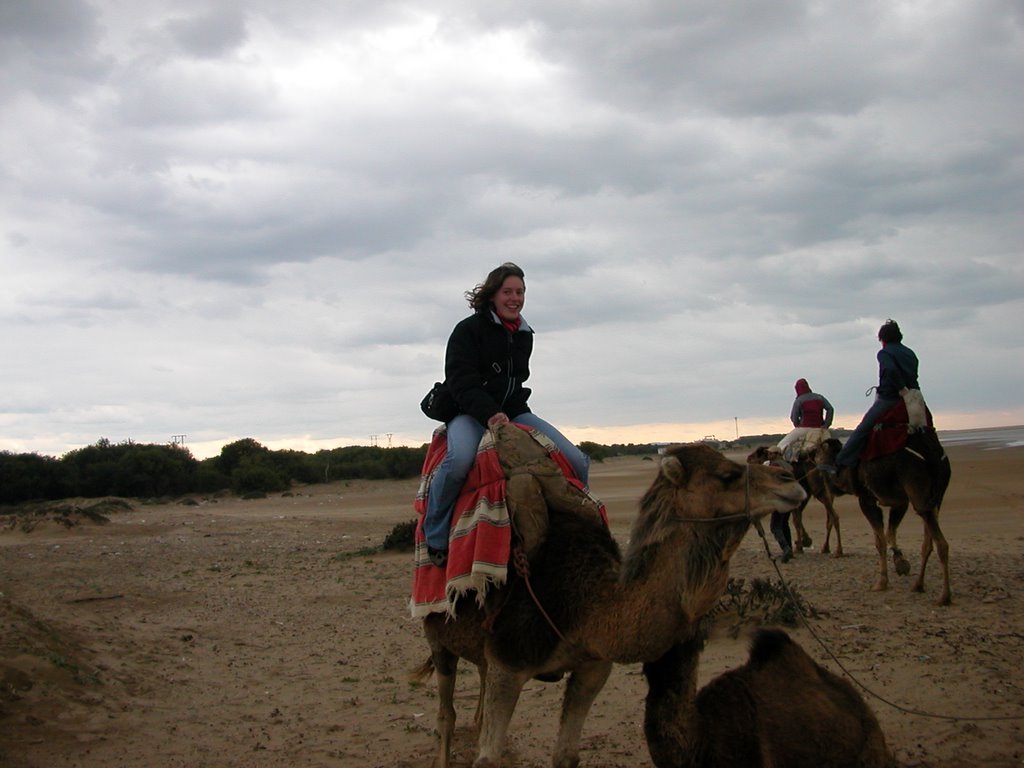
That's me. On a camel. On a beach. In Africa. How amazing!

Sunday, February 19, 2006

Nuns don’t say hombre. Hambre.

I signed up to volunteer at a comedor social this week, getting up at 9 on Saturday, but doubting it would really happen as I followed a pencil “x” on my internal map to its supposed location. It was there as promised, the only comedor social in Triana on c/ Pages del Corro, and I was on time. Still doubting it would happen, I walked in and somehow got myself through the front line nun and inside to another nun who, as I expected, didn’t really know what we were supposed to do. No matter, she put us to work sorting, folding, and organizing clothing donations, grateful for our opinions on whether or not certain items were “mono” (literally, monkey, but colloquially, cute or fashionable).

At lunch time we got shepherded to the soup kitchen, which was serving fried fish (the same type my señora feeds me with bones and skin still intact), bean soup, salad, chorizo, bread, and oranges. A far cry from the pig hearts and greasy cream of wheat the San Diego soup kitchen serves, I must say. The building even, which was meticulously clean, decorated with Sevillian white-and-blue tiles, and surprisingly high-security, was much nicer than St. Vincent de Paul. Even though I only helped with the dishes and listened and nodded to a lot of Spanish, it was really quite a brilliant way to spend a Saturday morning. Indeed, people without food from any country look the same, and it seems like the comedor needs the help feeding algunos de los pobres de Sevilla.

Before I lived in a hotel, I used to walk down the tunnel that is c/ Republica Argentina because of metro construction twice a day, sometimes more. Even though Los Remedios is one of the richer areas of town, along this route I would see the same homeless people every day. There’s the man in black with scraggly dirty blond hair who camps out between McDonald’s and Vips with an electric guitar, a big green hulk hand, and two amazingly obedient dogs. Sometimes his friend, a slightly more transient fellow with long black hair and a beard, a hat, and a puffy white jacket, joins him with a couple liters of Cruzcampo. Then there’s the woman who sits right in front of the door of Plus Superdescuento holding a sign written in bad Spanish. There’s a gypsy woman who wears a long black skirt and a black shawl over her head who sits in front of a bank in one of the darker stretches of the tunnel, calling out to people as they walk by to give her money. On good days there are two accordion players, one older man by Aromas Perfumería, and one younger guy with a green jacket who stands by one of the many Telebanco cajeros automaticos. And though I never see him in the morning, this list would not be complete without the skinny, timid Asian man who haunts Plaza de Cuba, Calle Betis, and surrounding areas every night of the week, his hands ironically full of fake flowers and blinking lights.

(Wednesday night addition:)
I was walking along the street today with my cell phone in one hand and my soaked umbrella in the other, lost in thought over whether I should return the call of a Spanish guy in one of my classes and risk todo el mundo and him hearing my awkward phone Spanish, or whether I should tomar un cafelito wait and risk forgetting or losing my nerve. Somewhere in my twilight zone of thought I heard, "Niña, tiene unos centavos" and vaguely saw a woman with a suitcase off to my right. I quietly replied "No," but I guess my face flickered confusion or distaste because she started yelling after me, something about how she wasn't trying to steal anything. Actually, I have no idea what exactly she said, but I got the impression at the time it was something about stealing. I felt really bad after, as I kept walking, snapped out of my deep decision-making. I didn't mean to do whatever it was I did; I wasn't really paying attention and I wasn't prepared to interact with anyone on the street. Only the Spanish boy. Who I forgot to call.

I’m (still) going to Morocco on Thursday (tomorrow).

Monday, January 30, 2006

Orange you glad i'm posting again?

You know it’s been raining because there are oranges everywhere – smashed and whole, they sit soggy on the streets and sidewalks. Sevilla is even less prepared for rain than Santa Barbara, if that’s possible, and the calles estrechas become rivers and it’s more likely than not a car will drive in a puddle and get your pants wet. It’s impossible to walk my 30-minute walk and stay dry.

But Seville needs its water, so we all bear it. It’s just really serious about its rain. When it rains, it rains nonstop all day. When it doesn’t, it’s sunny, without a cloud in the sky.

There have been better nights to walk halfway across town to see a concert. But what a concert. Only in Spain. A very British man that spoke perfect Spanish to the crowd, but sang in English; and a very British man that didn’t speak a word of Spanish save “Gracias” and sang in English. It was British pop, recommended to a friend by the owner of an indie record store in the area. Though I’m not used to seeing bands with keyboards instead of drummers, it was very enjoyable. One of my favorite bands is playing in Madrid in a couple weeks, but it’s the same weekend the magazine I’m working for is taking us to Morocco for free…tough break.

Pomegranate


The bus was silent. A bus filled with 50 some college students. At five in the afternoon, the majority were sleeping.

I guess that means our trip to Granada was collectively good.

We made our way east this weekend, a caravan of four buses filled with students who probably shouldn’t have gone out Friday night. Nonetheless, we escaped the rain in Seville this weekend in favor of a little mountain pueblo called Granada, which means pomegranate. Drought considering, I was surprised to find the open terrain of Andalucia very green. The olive trees were plenty, as was the grass, trees… and as we made our way further east, there were mountains. Not much development, not many cars, just the simple beauty of nature.

The weather was dry for awhile. But the clouds became darker, and the streets got wetter, and as we curved our way further into the mountains there were hints of snow. Far off snow-capped mountain peaks you might see on your way to Las Vegas, and then closer hills painted with a layer of white. First there was rain, then sleet, then snow, and pulled into the white wonderland of hills and trees that frame the lovely Spanish city of Granada.

In many respects, Granada looks much like Sevilla. Of course, it snows about as often in Sevilla as it snows in San Diego, but as far as architecture goes, the plazas, fuentes, churches aplenty, and cobble-stoned streets all have a similar look. Granada’s claim to fame is that it was the last Muslim stronghold in Spain before being recaptured by the Catholics. The Middle Eastern ambiance of the city is unmistakable. A group of us piled into a tetería today and experienced an expansive selection of Arab teas, each order coming with a metal tea pot filled with various plants and spices and a little decorative glass a bit larger than a shot glass. We sat on cushioned benches around the perimeter of a tiny room with mirrors that we had to ourselves. It was Spanish, with the language, with the relaxed way of life, but the skinny cobbled streets were lined with colorful wares from Morocco instead of oranges.

With just barely 24 hours to explore, there was limited time to enjoy this important pueblo… but breve y bueno, dos veces bueno, right? (a Spanish saying that’s similar to “short and sweet”) The most magnificent part of the weekend was certainly Alhambra. On the list for the second wonder of the world, I believe, and by far the most diverse, most ornate, most beautiful collection of buildings, gardens, and views I’ve ever seen. I can’t quite explain it in English, because the experience was truly Spanish and truly in Spanish, but perhaps my photos can speak louder than my words.