Wednesday, April 19, 2006

Tengo un nuevo "look"


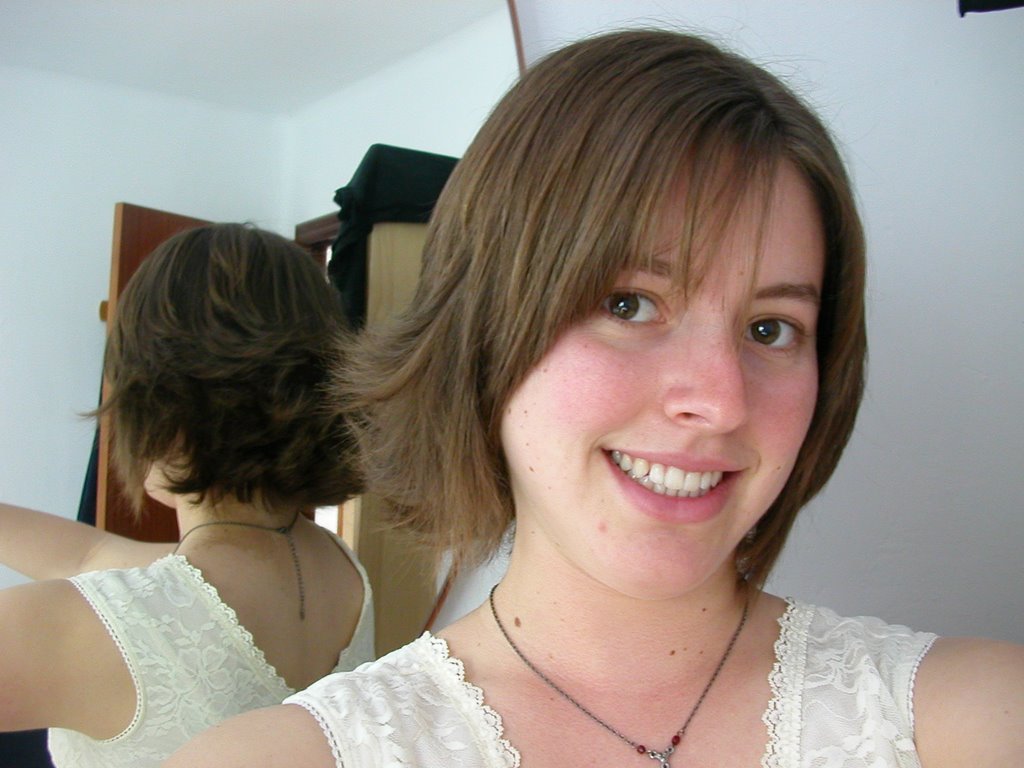
Look is a Spanish word that means, well, look. Style. And hombre, it's been many years since i've had a new one. So after walking the streets sufficiently to develop a taste for Spanish hairstyle I looked up some words in my dictionary (bangs=flaquillos; layers=capas; blow dry=peinar) and set off to find a decent peluqeria. There are actually five on every block in my neighborhood, so it was a tough choice. The first one I entered had about six old ladies getting their hair done, so I felt a little uncomfortable, and it was so loud that I couldn't hear what the lady was saying. I walked out and down the block to one that looked more hip and private with orange and green paint. After finding mas o menos the style I wanted in one of the magazines and trying to expain it with my non-haircutting Spanish vocabulary, it took her about 15 minutes to cut bangs and layers change my part. And that was that. For 12,50!!!!

So if I don't look more Spanish... at least I have a nice change that the hairdresser proclaimed to be gracioso and chulo after she was done. (Gracioso meaning... something good, and chulo meaning cool in a suave, slicked back hair, black suit kind of way -- not that I look like that.)

Sunday, April 16, 2006

choices


Way back when studying abroad was just a dream and I was choosing between five different programs and thirteen different cities, Sevilla sounded livable because of its friendliness to students, its moderate size, and its cultural and religious history – a mix of Muslims, Jews, and of course, Catholics. I heard stories from a friend who had studied in Spain and dated a nice Jewish Spaniard, and from a teaching assistant who had lived there, and was sold. Maybe Spain isn’t as infernally hot or as devoutly Catholic as everyone says.

Here I am three months into my stay. It was cold for awhile but now the digital thermometers on the farmacia signs around town regularly register between 25 and 30 – in April. It’s the middle of Passover and I’ve eaten a thick, fluffy baguette for breakfast and lunch and this morning I followed Jesus and the Virgin Mary around town in honor of Domingo de la Resurrección (Easter). I went to my program activity office at the beginning to inquire about a synagogue and was told there are approximately five members, the phone number is disconnected, and services are held in an unlabeled building on a rather shady street. I didn’t bother, and I didn’t really notice any other type of religion besides the tiny grey churches on every other street until this week – Semana Santa.

Understandably Saint’s Week, the week that begins with Palm Sunday and ends with Easter Sunday and mourns Jesus’ crucifixion and celebrates his subsequent resurrection, is a big deal for a Catholic country. Even if history has left a few ancient mosques in Andalucía and three synagogues in Spain it doesn’t change the fact that los Reyes Catolicos revamped Catholicism in the late 1400s while expelling everything else, and Spain hasn’t been religiously diverse since. (The very same Catholic royals, Ferdinand and Isabella, sent Cristobal Colon/Christopher Colombus, whose remains are in Seville’s catedral, to Asia in 1492 and he ended up founding America but never knew it.) Religious unity is something that the obviously U.S. lacks, and it seems kind of nice, because besides country pride and region pride, Spaniards have a country-wide sense of religious unity and tradition in that comes from Catholicism.

The traditional aspect of the Semana Santa celebration in Sevilla is refreshingly ancient and beautiful. Parades of pointy-hooded nazarenos, cross-carrying barefoot penitentes, and elaborate saint’s week scenes float through the city thanks to an army of 20-40 costaleros who hold the huge heavy floats from underneath on the backs of their necks in tune with the mournful whining music… Catholicism aside, it’s amazing, breathtaking, and solemn. But this morning as I was pushing through a crowd trying to get to a good spot from which to view the final procession of the week, I realized that it’s still Passover, I was wearing a Star of David, and following a float that depicted Jesus with bloody hands and feet and a gold crown, ascending up to heaven.

It’s hard to tell how religious Spaniards actually are. My señora for one doesn’t ever go to church, but she does pray each night before bed and her room is decorated with a picture of Jesus above her bed. The rest of the Sevillian and Spanish tourist population seems to turn up on the streets during Semana Santa en mass at all hours of the day and night to view these processions. Some choose to be band-members, costeleros, nazarenos, and penitentes for their own church’s processions. Everyone dresses up in suits and skirts or dresses, and Spanish women dress in black lace on Friday as a sign of mourning. Some buy seats for 200-500€ each on the parade route, or inherit bleacher seats. Kids get involved too, some donning the nazareno costumes, and some running through the processions in their little spring dresses or suits asking for candy and pictures of that particular church’s Virgin Mary. Still, everyone seems to go out for drinks and tapas as usual.

I’m not actually going anywhere with this. Out of all the cities I’ve visited in Spain, by now including Granada, Jerez de la Frontera, Cadiz, Malaga, Utrera, Madrid, Toledo, San Lorenzo del Escorial, I still like Sevilla the best. Despite the Catholicism, all the Americans, the impending heat, the walking, and everything else I complain about, it’s pretty near perfect. I think my mom agrees.


At the Alcazar... a sight in Seville i'd actually never seen before. It's almost in another dimension, so hidden behind houses and the depths of the old Jewish quarter that you never realize it's there, or that it's so big and beautiful.

Wednesday, April 12, 2006

hola from MADRID

If you haven't heard much from me lately, or my mom, it's because she's here and we're in MADRID. We've been traveling and walking and sight-seeing for five days and we head back to Sevilla tomorrow to catch the tail end of Semana Santa. I will be sure to post photos and stories of all our travels... but for now I will leave you with a saludo and a little summary. Toledo. El Escorial. Reina Sofia. El Prado... there are people waiting. And the night is young!

Wednesday, April 05, 2006

times like these

There’s a forgotten stairway at the University of Seville that is protected by a metal detector and a couple of guards. Now I understand why.

They guard the Parainfo room, a lecture hall for distinguished guests that’s carpeted and has cushioned red velvet theater-style chairs, long red curtains, and big paintings of famous people. In front is a long wooden desk like one might see in the dining hall at Hogwarts, but today instead of Dumbledore sat the director of my study-abroad program, an important school official, a man from the government (minister of culture I believe) and a few others who looked important – all four wearing formal black or black suits. To their left sat a grey, slightly overweight bored-looking man in a light blue polo shirt – Raúl Rivero.

Before I got involved with this magazine más o menos I didn’t know who he was either. And I still won’t lie and say I completely understand what he stands for. Basically, he’s a journalist and poet from Cuba who was jailed for 20 years for reporting the truth for several U.S. newspapers during the time when he, as a Cuban citizen under Fidel Castro or just during and after the revolution, didn’t have the right to free speech. Now he writes for El Mundo, one of the more neutral national newspapers in Spain, in Madrid, because he was exiled from Cuba, of course, for writing. “Charla con Raúl Rivero.” Interesting.

So the university official and government official started off the afternoon giving long speeches about his accomplishments as at any lecture. I won’t lie again and say I really understood anything of what they said, partly because I ran in a bit late and was trying to get settled and skim the folded papers I was handed as I sat down. After the intro a few people from the audience started standing up and reciting passages from little pieces of paper in fast Spanish, while the audience clapped. I didn’t really I understand them either, but I clapped along because I thought they were the final straw in the kick-off to Raúl, reciting his poems or something. Some of them seemed nervous and shaking as they spoke.

But after several of these recitals it became evident that this wasn’t planned and the officials at the wooden desk started yelling though the microphone to regain order and continue the talk. But the audience continued their reciting and their clapping. They stood up with posters and chanted and kept yelling over the people with the microphones, rejecting any suggestion to stop and talk. Chanting, posters, clapping, yelling, a group at the front of the room held up white painted sheets and a flag with their messages in bold capped letters. The 30-plus people in the audience continued their yelling until the officials gave up at trying to continue the lecture and ushered Raúl and the rest of the bewildered, angry, scared, disappointed audience out of the room.

The group was pro-revolution, whereas Raúl is pro-free speech, the group thinks Raúl is an agent for the CIA and demands that the United States free the five Cubans from the revolution that are still locked in Guantanomo Bay.

There was one part of the protest, when the anti-US energy was particularly high and the yelling of the university official was particularly instant and the protestors were particularly angry and defiant with their claps and yells and posters that I thought there was a possibility that someone would do something violent. I looked around at the audience of black and dark brown wavy-haired Spanish heads and wanted to run out of the room or hide my golden brown hair and pony tail – so obviously the enemy. And even though I’m not always proud of my country and the things we do and the way people act, it was still diminishing and powerful and scary as hell for a room full of yells in Spanish to be directed at you, your friends, and your family. Or if not them, at least the law of the land they all reside.

I don’t even understand what you’re saying, the history behind the conflict, the facts… but I understand that your posters are anti-US and pro-socialism and pro-revolution and there are no security guards nearby and you won’t shut up – I don’t know what you’re going to do next.

My friend claims that when the situation first started getting out of hand Raúl said into his microphone (in Spanish of course), “I didn’t go to prison for 20 years for nothing. Let them speak.” But nonetheless, he didn’t speak, and El Mundo reported the next day that this is only the third time in the history of the university that someone hasn’t been able to speak – the other two were during Franco and the Inquisition.

Free speech is the freedom that permits me to do what I do, to write on this blog and publish it internet-wide, to write new for my school newspaper, to write for this magazine… but that doesn’t stop the fact that I was scared out of my mind at the simple, random, loud oral expression of it directed against the US.

Monday, April 03, 2006

time is flying

Without realizing it I have become mostly accustomed to Spain, Spanish, and its little annoyances. In an effort to rekindle my curiosity a bit, i've been compliling a list of things that are still weird.

Judias verdes. Direct translation: Green jews. In other words: Green beans.

Supposedly the word comes from the shape of the Jewish nose. I didn't believe it at first until I saw the word on a jar in my frigolifico. Maybe it's just me, but that sounds like a derogatory term. I guess considering the not-so-friendly history the Spanish have had with the Jews, it makes sense. It also helps to explain the fact that there are about six jews in Sevilla.

"Los moros no están en la costa." Direct translation: The moors (African muslims) aren't on the coast." In other words: The coast is clear.

You've got to know a little Spanish history for this one too, because the moors occupied Spain for hundreds of years. When the catholics finally took control again in the 1400s, I would imagine they were very happy to be rid of the moors, which is why they built cathedrals on top of all the mosques and ripped down remnants of the past. The coast wasn't clear for a good, long time. And the coast still isn't clear in a sense, because even though the moors are no longer trying to invade, shiploads of African immigrants seeking a better home arrive on the shores of the Canary Islands every week. And tragically enough, many shiploads have also been found shipwrecked in the past few weeks, thousands drowned just trying to get to Spain.

Sunday, March 26, 2006

the problem with English

The temperatures are climbing up to 25…28… on the digital thermometers on pharmacy signs and street corners. The Spaniards are still shuffling around town in their winter coats, boots, and tights, while the Americans stick out like sore thumbs in their flowery skirts, tank tops, and flip flops. One of my professors said winter fashion sticks around among Spanish women until Semana Santa/ Feria (middle to end of April).

My California blood thinks this is hot. The temperature supposedly gets up into the 50s during the summer, which is roughly 200 degrees fahrenheit according to my Spanish buddy’s iffy conversion skills (to which I replied “¡No puede ser!”). But the heat isn’t the point, though I’m a little afraid I’m not going to survive. It’s the division in fashion, as in every other aspect of life, between Americans and Spaniards.

The most prevalent image of the American college student in Seville is similar, if not identical, to the American college student in general. The blonde who staggers up to the hamburger stand on calle Betis at three in the morning with heavy makeup, high heels, clothing not appropriate for the season, looking a bit disheveled and most likely drunk. Then she says in the most annoying non-Spanish accent ever, “Por favor, puedo tener un hamburger con (pointing) esto, esto, esto… and carrots. How do you say… Como se dice carrots? Zanahorias. Quiero zanahorias también. Gracias.”

Cultural interlude…
Instead of going for the more polite, please and thank you English way of asking for something, Spaniards generally don’t say please or thank you and go straight for the direct “Dame una hamburguesa.” (command: Give me a hamburger.) So perhaps I can’t blame someone for not picking this up, I for one feel as uncomfortable saying this command to shopkeepers as I do saying “Dime” or “Si” when I answer the phone (you informal command: Tell me or Yes instead of the American way, Hello or Hi). In fact, I usually try to avoid saying the commando shopkeepers taltogether and go for the more ambiguous incomplete sentence “Una hamburguesa.”
…

In any case, this is the American college student that I always exchange looks with my friends should I happen to see her and hear the ominous “Puedo tener…?” This is the image of the American college student that I feel I have to constantly have to erase from Spanish people’s minds. The American college student that is studying abroad to experience the nightlife, to speak English, to do anything but learn about a different culture or a different language. Because I am the American college student who isn’t blonde, doesn’t wear heavy makeup or clothing not appropriate for the season, and tries her very hardest to speak Spanish correctly, to fit in, and most importantly, to learn.

Maybe this isn’t my problem with Americans. But I think its part of my problem. I was walking with a friend yesterday and we ran into a Spaniard who he knew from one of his classes. They talked for a bit about the class, the homework, and went their separate ways… I commented that the guy seemed pretty cool, pretty friendly; someone my friend should get to know better. As it turned out, they went for a few drinks after class and the guy was talking about how Americans separate themselves by speaking in English. And there are so many of us, so we’re always separated from Spaniards by language, even if we do speak Spanish pretty well. I think if he went to Santa Barbara he would speak in Spanish with whoever possible because it’s hard and scary to be in a country where you’re always a little bit under water about what’s going on, but regardless, I wish we were better. I wish I was better. And I could be better, but I don’t want to completely forget about my American friends either.

I’m volunteering at an elementary school two mornings a week, helping the two English teachers at the school with their English classes of various levels. Yesterday I was reading off words to the more advanced class for a dictation test, and none of the kids could understand my American pronunciation of the words. No one really had a problem with it, the teacher just re-pronounced the words and moved on, but American just seems to be the more inferior brand of English in this neck of the woods. And American people in general; maybe that’s my problem.

I got in a little disagreement with a friend at an Indian restaurant on Monday about speaking in Spanish. The funny part was that we had the disagreement in Spanish… And the restaurant was small, there was a British couple, two Spanish couples, and the waiter spoke everything. I always want to speak in Spanish as much as possible, because I’m here to hopefully become sufficiently fluent and I feel like I’m not getting the most out of my time here if I’m not. He argued that we wouldn’t have the same relationships with our American friends if we spoke in Spanish more than English. It’s certainly an interesting question. But as I was telling my Belgian friend last night in Spanish (even though she speaks English we only speak in Spanish), I don’t feel any different with her than I do with anyone else; the language doesn’t hinder my personality.

Even so, after a whole day of writing in Spanish, listening to professors in Spanish, and speaking to my international friends in Spanish on Friday, it was nice to relax a little with an American friend… in English.

Note: I wrote most of this post a few weeks ago when it actually was starting to get hotter, but then it got cold again and rained for a whole week… and now it’s kind of nice again. But we’ll see.
Wednesday, March 22, 2006

You. Me. Him. Her. Them. Us.

I have problems with pronouns.

Spanish is organized in such a way that often it is not necessary to use pronouns. The ending of the verbs indicate the subject of the sentence, and the two letter object pronouns indicate the object. It’s pretty straightforward, but you have to know what you’re saying before you say it or else you’ll get hung up on the objects that go before the verbs and the subject that determines the end of words. My comprehension of Spanish, both written and spoken, is very good, but I still get hung up on the pronouns, or lack thereof. It can be very ambiguous, especially for the careless listener. The gender of the subject is oftentimes hidden, and the subjunctive form of verbs further puts an air of uncertainty on the sentence. The verb ending for el, ella, and usted (him, her, and you formal) is the same, so for me it gets very awkward trying to address someone formally because I feel like they don’t know I’m talking to them. Subjunctive further blurs the lines, because it indicates doubt, uncertainty, and the desire for someone to do something. Today in translation we were translating instructions for the installation of a CD-ROM drive in a computer, and the most recognized way of writing instructions is using the you formal command, which is in subjunctive. So translated it’s kind of like, I command you to do this… if you want.

If any of that makes any sense. Lately I’ve been noticing that people’ll be talking to me, and they’ll say something that I understand, but then they’ll look at me, and they’ll wait for a response. And then I realize they were talking about me, and I say, “¿Yo?” or sometimes I forget myself and say, “¿Mi?” like the English me. The other day I was standing with a friend, half listening to his conversation with our magazine advisor. And then I realized he (notice the ambiguous he) was talking to/about me, so I said, “¿Yo?” really loud. I need to get over that. Obviously if someone is talking to me they’re talking about me.

upsidedown and backward

The university is equally as ambiguous as the pronouns.

The main departments of University of Seville are in this massive white concrete square building with Corinthian pillars and four entrances. When Sevilla was a big port city (thanks to the fake river/canal) it was the tobacco factory, but in 1501 or so the fabrica de tobaccos moved across the river to where I live, Los Remedios, and the old fabrica became a university. Now the inside floors are mostly white marble, two stories of endless aulas and libraries without clear signs. Class scheduling is nightmarish, and at least once a week the students get to class only to find that the room as been changed, or the professor decided not to show, or he’s just 15-minutes late… Today I knew something amuk when the filología department held an assembly in the room I have my classes in. So we stood there for awhile, no one knowing where to go, no sign on the door, and no where to check. We were eventually herded into another room, the room we were originally assigned to for the class, but that was changed the first week. The second class was the same, even the professor didn’t know what was going on. I really don’t understand how it all gets done.

As a result of all this waiting around, we were talking before my relato (short story) class about the striking resemblance the teacher has to Horacio Quiroga. Quiroga happens to be the author we’ve been studying for the past two months and the very same author who inspired the name of my blog.

I promise, though, that not everything is backwards or, if not backwards, then different than i'm used to. Because even though the buses are slow and unreliable, the university doesn’t know where its classes are, and my señora still doesn’t have a phone…it’s not all like this. I visited friends in a little pueblo of Sevilla (Utrera) this weekend, and three of them (the German, the Colombian, and the Guatemalan) live in a beautiful little apartment that isn’t freezing cold, has a microwave and an electric stove, a little interior patio to hang their clothes, and the toilets flush toilet paper. It’s also like a quarter of the price of living in Santa Barbara!

current events

Big news today: “ETA anuncia un alto de fuego permanente.”

I really had no idea what this meant. I knew I had seen ETA before, but I thought it was the name of the government or a political party in Catalunya. The alto confounded me, because it usually means tall, or raise. Fuego? Fire? After a series of questions to my señora and intent listening of the news I finally got it. ETA is a Basque terrorist organization. An “alto de fuego” is a cease-fire. Permanente? Well I’m still a little shaky about whether or not the cease-fire is permanent or temporary, because my señora seemed to think it was temporary… but reguardless. Big news.
The NYT explains better than me.

Friday, March 17, 2006

F is for Friday

I was intercepted by a woman in red and white stripes this morning. She cornered me in the middle of a plaza with her microphone and her cameraman and I stood bewildered as she spoke to me rapidly in Spanish. "No hablo español muy bien (I don't speak Spanish very well)," I stammered. She smiled and rephrased her question. "¿Viniste a Sevilla con una agencia de viaje? (Did you come to Seville with a travel agent?)" "No..." and she looked puzzled, so I continued, "Estoy aquí con una agencia... programa de estudiar... en otro pais (I'm here with an agency... a study program... in another country)." She gave me a weird look and said "Muchisimas gracias" and moved on to her next victim.

That was pretty much the worst sentence i've ever formulated in Spanish. I could have said so much to make her think twice about ever stopping someone on the street again, assuming they're a tourist. But instead I floundered like the foreigner I am.

Wednesday, March 15, 2006

and the heat begins

My first direct contact with the Mediterranean Sea, and I was lounging at the top of a colorful rope jungle gym on the beach with two little girls and my travel companion. Little girls of their age – about nine or ten – haven’t yet learned small talk skills, but we had nonetheless fallen into the tried and true discussion of travelers – languages. I thought they were speaking French when they first ran up, but they later interjected British English into our conversation, asking where we were from. It turned out we knew five languages between the four of us, English and Spanish of course, and three others that one of the girls proudly rattled off. They soon skipped away down the dusty beach, taking some of the pressure off the rickety jungle gym and leaving me to contemplate the ocean, the sunset, and the Spanish air that suddenly got warm.

Malaga looks like Hawaii, like Puerto Vallarta, like Oregon, and the little inlet and stretch of Goleta Beach off to the east side of UCSB’s campus. It’s Sevilla without the high fashion, the skinny, cobbled streets, the shopping, and the construction. It’s slightly industrial on its shores, but its sea breezes whisper “vacation…” Perhaps because I was just there on the weekend, but it seemed sleepier than Sevilla somehow, even though I slept five floors up on the main road with my windows open. I have heard from several Spaniards that Malaga’s beaches aren’t ideal, and it’s true: the dusty sand turned my black shoes to tan. But the stunning views of the deep blue Mediterranean didn’t stop me from realizing how much I miss living on the ocean…

We spent our first three hours there wandering around the area west of downtown laden with backpacks, trying to find the cheapest hostel in town. At around four we started to get a little worried, our map and directions weren’t very good, and it was hot. We rode the bus downtown to try our luck at other hostels the guidebook recommended, and ended up in a 40€ room in a two-star, fifth floor hostel in an office building with a Ukranian front desk attendant that spoke thickly accented Spanish and addressed us with “ustedes” (you formal) like no Spaniard ever would. The room was painted yellow and white and had a shower and a sink in one corner, and a window in the other corner that overlooked the ocean. The plaza across the street played Latin American music from 10.30 to 22.30, and the cars on the busy street below ran and beeped all night long. On Sunday morning we threw leftover peanuts at passersby and watched as policemen attempted to stop traffic on the street for 15 minutes in order to let marathon runners go by.

Malaga is most famous for being the birthplace of Pablo Picasso. They have an amazingly comprehensive Picasso Museum with the most paintings by Picasso I’ve ever seen in one place… they also had a free concierge where we left our bags for the whole day! Some of Picasso’s most famous works, including Guernica, are in Madrid, but Museo Picasso was nonetheless amazing. They also have a big hill where the Alcazar and Catilla are located, a grueling walk, but worth it for the amazing views.

I’m going to stop before I start sounding like a guidebook.

Monday, March 13, 2006

lucky 17

¡FELIZ CUMPELAÑOS SARA!

I wish I could be there to celebrate with you... or buy you a ticket to celebrate with me in Spain.

Friday, March 10, 2006

la frontera: not that anyone will be able to read this

Pude ver el mar cuando me desperté. El mar bonito y calma, totalmente azul y verde como el cielo. Me imagino que, para la gente marroquí al lado de la calle, el mar también pudo representar oportunidad e imposibilidad. Porque al otro lado de esté pequeño mar había el oportunidad para una vida más rica, pero al mismo tiempo imposible porque ya no son allí.

El aparcamiento cerca de la frontera entre Maruecos y Ceuta, el territorio española, era llena de gente marroquí, cono al lado de la calle. Un inmenso sala de esperar con la esperanza tan cerca como la frontera con toda la gente que quisieron cruzar pero no pudieron. La cola de gente que nunca para y los policías que empujaron a la gente en la cola para mantener orden. Pero todavía no había orden en esta frontera, porque la gente estaba empujando y gritando también. Es una cuestión de dinero y comida, vida y muerto para ellos. Para mi, solamente una cuestión de mi billete de barco, pero pase por este cola de confusión para dar la policía mi pasaporte azul sin problema. La gente continuaba gritando en otra lengua. Soy un ciudadano afortunado de los estados unidos, y fronteras no significan casi-nada para mi pasaporte azul.

El área al otro lado de los policías había más tranquila. Un calle y acera como desierto, pero todavía inaccesible y extraña a los marroquíes en la cola.

Thursday, March 09, 2006

UN pensamiento...believe it or not

My memory of things that happen in Spanish is fragmented and unreliable. I find that when I’m recounting what someone said in Spanish later in English, I put into their mouths things I think they would say in English without really thinking about it. Automatic translation, taking into account facial expression, words, tone of voice. It’s really quite amazing, if not a bit unreliable. Perhaps not so much with the woman, except I promptly forgot after she told me how long she’d lived in the building, substituting instead “a long time.” A more potent example would be last night, when I was hanging out at a café/bar for several hours, (a “Spanish meal”) with two Spaniards and a girl from the Netherlands. Maybe it was just the feeling I got from the night, from the company, and from the stories (in English) I told about it after, but it seems that I was constructing these foreign friends into something I could understand better in my head. I only have a vague concept of conversation conventions and cultural norms in Spain, but by putting English words into their mouths they become something that’s not so different to me. Not so mysterious. And we get along just fine.

abuelita

There’s an old lady who lives in my building that I see every so often when I come home for lunch.

She stands with her cane on the step before the door in the shade waiting for someone to come open the door. She has keys, but I think it’s hard for her to use them because the lock is temperamental and the door is heavy. So she stands there, saying as I walk up smiling, key in hand, that she has all the time in the world and she doesn’t mind waiting.

Then she ushers me in and up the stairs before her, calling me hija, saying hasta luego before our conversation is over. She shuffles across the floor toward the stairs and tells me “poco a poco.” Little by little.

And I still hear her shuffling and grunting up the stairs as I unlock the door to my third floor apartment.

Sunday, March 05, 2006

Citrus


I was sitting comfortably on the patio of a Moroccan household in the middle of the medina in Rabat on Friday laughing as hard as I’ve laughed since I’ve been abroad. The woman of the house, fifty-three with a white lace veil covering her face and a pink bathrobe, had just forcibly persuaded Esteban, the American man of our group, to eat a huge orange with only a smile and some words in Arabic and French. We had just eaten a huge and delicious meal of olives, round white bread, rice, Coca Cola, and a veggie and chicken stew with our hands. Our collective laughter was echoing off the colorful tiles and the high ceilings, louder than the droning of Arabic and French on the television.

So we lived for two days. A Californian, Texan, and Minnesotan adopted into a family of seven Moroccans: a mother (whose husband has passed away), and their three sons and three daughters, ranging in ages from 31 to 11. It sounds like the setup to a bad joke, but it was truly amazing being a part of this cohesive family for a couple days, even if they didn’t speak much English. The truth is (and I reiterate), you don’t need a common language for jokes to be funny, photos, facial expressions, and video games, or sitting around the patio on a Saturday night with the whole family snacking on baked goods for dinner while the rain pounds on the sky light. The family bond was tangible, in Morocco as well as Spain, and it was obvious there was no place any of them would have rather been.


The concept of privacy in Morocco, as well as Spain, doesn’t exist. In fact, there is no real word for privacy in Spanish, but the concept has developed in recent years along with the English-derived word “privacidad” (o algo así). The house we stayed in consisted of, aside from the patio, a kitchen, and two bathrooms, four rooms with cushioned benches lining the walls. Downstairs these rooms were colorful and ornate, to be used for eating, formal occasions, family gatherings, or sleeping. Upstairs, most of the family members that didn’t sleep elsewhere slept in a particularly big room, while the three Americans slept in the other. We were given two furry blankets, a pillow, and a section of bench each. The youngest daughter of the family (age 11) was, it seemed to us, the “Cinderelli” of the family. She was up at the crack of dawn helping to make breakfast or running out to buy some last minute items, taking out the trash, making beds, answering the door, serving and clearing our breakfast and other meals of the day (basically, doing jobs the youngest of my family would never stand for). She was the only family member who was monolingual in Moroccan Arabic, so communicating with her was hopeless besides smiles and the occasional badly pronounced word or phrase from our Lonely Planet guide to her language. The rest of the family spoke at least a couple words of English, at least enough to generally communicate with the three of us who were full of questions and thanks.


Los chicos: Esteban (el americano), Adiel (oldest boy), Monsef (youngest), Ishane (middle).


Las chicas: Nadia (the youngest girl), the cat Leo, Fatimazara (middle), Brett (la americana), ME (la otra), Keltoum (la madre), Hanene (oldest).

Just meeting this family shattered all my stereotypes about the Muslim/ Arabic world. Morocco is 98% Muslim, 1% Christian, and 1% Jewish. Moroccan Arabic is a separate dialect from written Arabic, and the languages/dialects that are spoken in other Arab countries. Five times a day there is an eerie call to prayer that permeates every windy street of the city, and many women choose to wear veils. But not everyone prays or covers their skin, just as not everyone abstains from drinking, smoking, or physical contact with the opposite sex. It’s just like anywhere else in the world.

Tainted


I awoke Monday morning to the sunny Mediterranean Sea just coming into view… a greenish blue calm settling over me, accented by the surprising silence of the 15 of us in the van. It was a long four days, and as we drove along the road bordering the sea I think we were all thinking about how exhausted, dirty, and changed we felt. Either that, or we were sleeping.

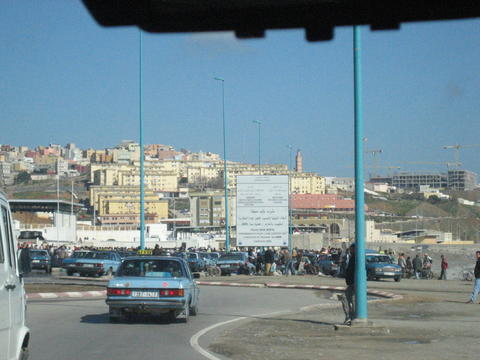
The view was what you might imagine of the Mediterranean: green grass, blue water, sun, a jagged coastline dotted with buildings in the Andalucía-white style. We were headed from the little mountainous town of Chefchaouen to the port, which happens to be in Ceuta, a city in the only region of Morocco still owned by Spain. The poverty of Morocco continued along the sea as we drove, little shacks and souvenir stands on what would be couple-million-dollar property in California. The people were plentiful, walking along the road, most women veiled and most men robed. Where they were going, I don’t know. The parking lot before the border between Morocco and Spain presented the same mystery. It was filled with people, some selling wares, some waiting, and many starting at the 15 of us as we unloaded the van and made our way to the border windows. As we were waiting for our departure from Morocco to be verified, the line of pushing and shoving Moroccans waiting to get across the border got longer and louder. When my passport was stamped and ready, I followed my professor to the front of the line, and watched as the border official yelled at people in Arabic and beat them back to make way for me and my fellow, legal American travelers. We walked rapidly along the sidewalk of the no-man’s zone bordered by high fences and barbed wire, until we finally passed the gate into Spain, the ocean still adjacent but barely visible over the walls and fences surrounding us.


This border between Morocco and Spain in Africa “el tarajal” is the most unequal in the world. The difference in per capita income between third-world Morocco and first-world Spain is astronomical, and this small seaside town of Ceuta is where it all comes to a head. I knew Moroccans had problems getting permission to travel to other countries, because I had several conversations about the matter with three Moroccan friends a few days before in Rabat (the capital). But I wasn’t prepared for the extreme confusion, the frustration, the desperation I saw in the faces and actions of the people at the border. I have no idea what was going on; the languages these nameless faces spoke were French and Moroccan Arabic…possibly others…and it was obvious that the border guards weren’t keen on letting them through for whatever reason. Well, for security reasons, for law reasons, for income and political and nationality and motivation reasons. Maybe not for fairness reasons.


It’s hard for me to understand. I was fortunate enough to be born in the United States, so I’m allowed to travel anywhere in the world at my leisure with my navy blue VIP pass. People like my friend Amine, a bright, motivated Moroccan student about my age who is fluent in Moroccan Arabic, French, and English has never traveled out of Morocco, and probably never will. Another friend Adnan is lucky enough to have traveled to the U.S. and Europe, and he’s hoping to study chemical engineering at UC Berkeley. But even though his family is in the higher level of income in the country, visas out of Morocco are hard to come by.

Yet they’re amazingly welcoming. I only saw this dissatisfaction and desperation in my last taste of Morocco. If I had written Sunday I would have started with this: (see above)

Photos in this post courtesy of Señor Esteban (who also has something to say about Morocco if you're interested). Thank you!

Tuesday, February 28, 2006

marueccos


Just to whet your appetite while I prepare my journals on Morocco...

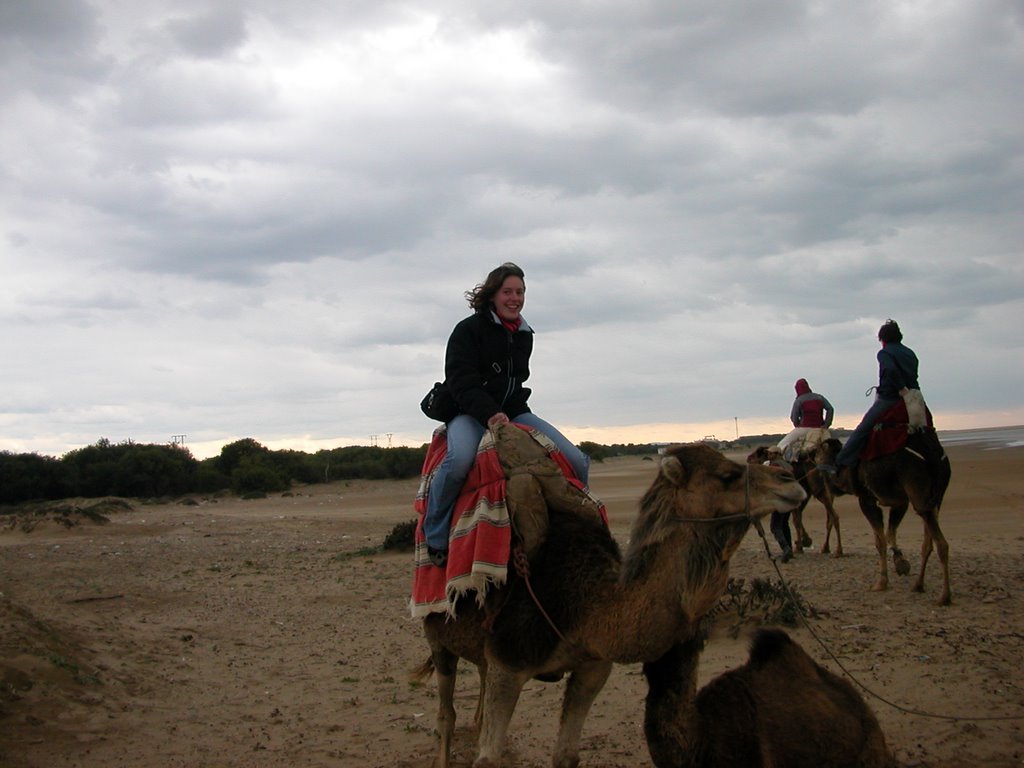
That's me. On a camel. On a beach. In Africa. How amazing!

Sunday, February 19, 2006

More of a journal and less of a blog

Extranjero, according to my Microsoft Word translator, is equivalent to the English word foreigner. It also bears a striking resemblance to the adjective extraño, meaning strange or odd (and, as my translator says, extranjero/foreign), and the verb extrañar, meaning to find strange or wonder at. “You don’t belong.”

Living as an extranjero en un país extraño, trying to become less strange and more comfortable, I have an extra sensitivity to this word. Because as long as I’m called extranjero, it means I’m not immersing and my language and appearance and customs are still strange to my surroundings. Immersion is hard to do; I don’t expect to miraculously morph into a happy s-dropping, c-lisping, boot-wearing Andalucían native after only six months. But I can try, at least, to exude more confidence in my speech and my comfort here.

Whether it’s nationalism or just something to talk about, I get a simple reminder almost every day from my señora that I’m still an extranjera. That I don’t exactly belong. The Spanish love their gossip shows, and conveniently every afternoon around lunch time there’s one on. We sit eating and watching the latest news about Spanish stars I’ve never heard of, European royal families, and sometimes more prominent American stars. Whenever, for example, the blonde wife of some Spanish fútbol player appears who’s obviously not Spanish, my señora says “Extranjera. Ella es una extranjera.” I know it’s not an attack against me or my success at immersion or my own birth nation, but it makes me a little mad every time she says it. She can call me her youngest daughter and let me live my life out of her house, but she can’t get past the fact that some people are born Spanish and some just visit. In recent weeks I’ve been replying, “No. No es una extranjera porque es de mi tierra. No es una extranjera para mi.” Maybe it’s different in America, because essentially everyone is an immigrant and an outsider. But I don’t go around labeling people as foreigners, because like the word extranjero for me, it has a slightly bad connotation. But here, where’s the tolerance, why can’t she accept that some people are blond, and some people don’t speak Spanish at all or very well at all. We all live on the same planet, and I came here to see what Spain has to offer me as a citizen of the world. Not as siempre, unavoidably una extranjera.

Nuns don’t say hombre. Hambre.

I signed up to volunteer at a comedor social this week, getting up at 9 on Saturday, but doubting it would really happen as I followed a pencil “x” on my internal map to its supposed location. It was there as promised, the only comedor social in Triana on c/ Pages del Corro, and I was on time. Still doubting it would happen, I walked in and somehow got myself through the front line nun and inside to another nun who, as I expected, didn’t really know what we were supposed to do. No matter, she put us to work sorting, folding, and organizing clothing donations, grateful for our opinions on whether or not certain items were “mono” (literally, monkey, but colloquially, cute or fashionable).

At lunch time we got shepherded to the soup kitchen, which was serving fried fish (the same type my señora feeds me with bones and skin still intact), bean soup, salad, chorizo, bread, and oranges. A far cry from the pig hearts and greasy cream of wheat the San Diego soup kitchen serves, I must say. The building even, which was meticulously clean, decorated with Sevillian white-and-blue tiles, and surprisingly high-security, was much nicer than St. Vincent de Paul. Even though I only helped with the dishes and listened and nodded to a lot of Spanish, it was really quite a brilliant way to spend a Saturday morning. Indeed, people without food from any country look the same, and it seems like the comedor needs the help feeding algunos de los pobres de Sevilla.

Before I lived in a hotel, I used to walk down the tunnel that is c/ Republica Argentina because of metro construction twice a day, sometimes more. Even though Los Remedios is one of the richer areas of town, along this route I would see the same homeless people every day. There’s the man in black with scraggly dirty blond hair who camps out between McDonald’s and Vips with an electric guitar, a big green hulk hand, and two amazingly obedient dogs. Sometimes his friend, a slightly more transient fellow with long black hair and a beard, a hat, and a puffy white jacket, joins him with a couple liters of Cruzcampo. Then there’s the woman who sits right in front of the door of Plus Superdescuento holding a sign written in bad Spanish. There’s a gypsy woman who wears a long black skirt and a black shawl over her head who sits in front of a bank in one of the darker stretches of the tunnel, calling out to people as they walk by to give her money. On good days there are two accordion players, one older man by Aromas Perfumería, and one younger guy with a green jacket who stands by one of the many Telebanco cajeros automaticos. And though I never see him in the morning, this list would not be complete without the skinny, timid Asian man who haunts Plaza de Cuba, Calle Betis, and surrounding areas every night of the week, his hands ironically full of fake flowers and blinking lights.

(Wednesday night addition:)
I was walking along the street today with my cell phone in one hand and my soaked umbrella in the other, lost in thought over whether I should return the call of a Spanish guy in one of my classes and risk todo el mundo and him hearing my awkward phone Spanish, or whether I should tomar un cafelito wait and risk forgetting or losing my nerve. Somewhere in my twilight zone of thought I heard, "Niña, tiene unos centavos" and vaguely saw a woman with a suitcase off to my right. I quietly replied "No," but I guess my face flickered confusion or distaste because she started yelling after me, something about how she wasn't trying to steal anything. Actually, I have no idea what exactly she said, but I got the impression at the time it was something about stealing. I felt really bad after, as I kept walking, snapped out of my deep decision-making. I didn't mean to do whatever it was I did; I wasn't really paying attention and I wasn't prepared to interact with anyone on the street. Only the Spanish boy. Who I forgot to call.

I’m (still) going to Morocco on Thursday (tomorrow).